DHF TS 013 – Code of Practice for the Safety of Industrial Doors, Domestic Garage Doors, Powered Gates and Traffic Barriers
The guide was created with the aim of:
- providing an operational tool for installers and maintenance technicians;
- clarifying the minimum level of safety required by legislation (Supply of Machinery Regulations, Construction Products Regulations);
- translating the requirements of the harmonised European standards EN 12453 and EN 12604 into practical guidelines.
- DHF TS 013 does not replace product standards for UKCA/CE marking (e.g. EN 13241), but is an application guide for on-site activities (installation, modification, maintenance, commissioning of existing systems).
DHF TS 013, published by the Door & Hardware Federation (DHF), is a technical reference specification for the safety of industrial doors, domestic garage doors, motorised gates and automatic vehicle barriers in the United Kingdom and Ireland.
The guide was created with the aim of:
- providing an operational tool for installers and maintenance technicians;
- clarifying the minimum level of safety required by legislation (Supply of Machinery Regulations, Construction Products Regulations);
- translating the requirements of the harmonised European standards EN 12453 and EN 12604 into practical guidelines.
- DHF TS 013 does not replace product standards for UKCA/CE marking (e.g. EN 13241), but is an application guide for on-site activities (installation, modification, maintenance, commissioning of existing systems).
Scope of application
The specification applies to:
- Manual and motorised industrial doors
- Domestic garage doors
- Motorised vehicle gates
- Automatic barriers
- Vertical doors such as roller shutters and grilles
- Among others, the following are excluded:
- lift doors, vehicle doors, special security doors, railway level crossings.
- The requirements apply to both ordinary doors and fire and smoke doors.
Main regulatory references
DHF TS 013 is mainly based on:
- EN 12604 – Mechanical requirements for manual systems
- EN 12453 – Safety in use of power-operated doors and gates
- EN 12978 – Sensitive protective devices (e.g. sensitive edges)
- EN 13241 – Product standard for industrial/commercial doors and gates
- The key concept referred to in the guide is that of “state-of-the-art”, understood not as “best available technology” but as the minimum level of safety required by harmonised standards and therefore presumed to comply with legislation.
Main contents - Compliance and Residual Risk Assessment (C&RRA)
A central element of DHF TS 013 is the obligation for installers and maintenance technicians to perform and document a
Compliance & Residual Risk Assessment (C&RRA) to be carried out:
- on new installations;
- when taking over an existing system;
- in the event of substantial modification.
Structural integrity and fall protection (fall-back)
Significant space is devoted to:
- the structural strength of load-bearing structures, fixings, guides, shafts, springs and cables;
- protection against the uncontrolled fall of vertical doors in the event of failure of a vulnerable component (springs, cables, gearboxes, etc.).
- A detailed methodology is also provided for assessing the conformity of existing doors without UKCA/CE documentation.
Electrical safety and control systems
DHF TS 013 refers to the obligations arising from electrical regulations (BS 7671) and machine safety standards, covering:
- electrical insulation and safe isolation procedures;
- IP protection rating of enclosures;
- mechanical protection of wiring;
- integrity of safety circuits;
- Performance Level (minimum PLc) requirements according to EN 13849-1 for systems installed after EN 12453:2017.
Mechanical risk control
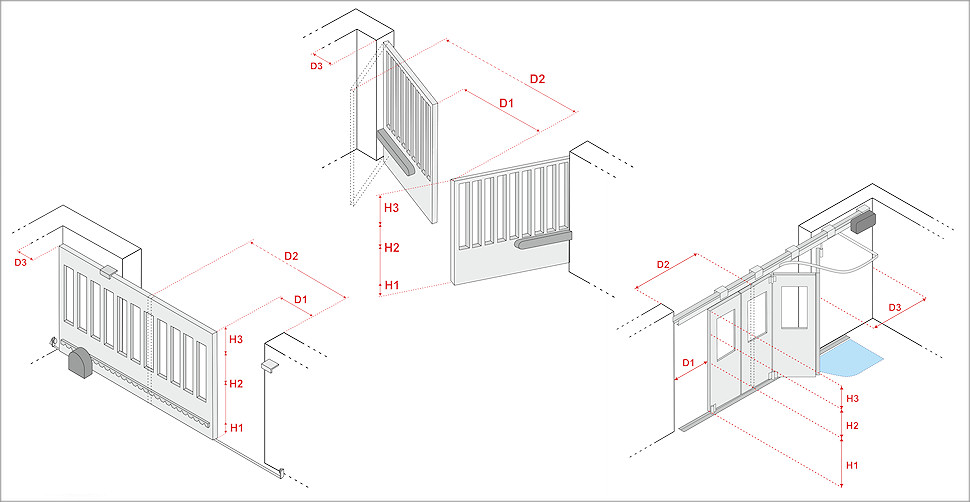
The guide systematically analyses the risks of:
- crushing
- shearing
- draw-in
- impact
- imprisonment
- lifting hazard
Role of DHF TS 013 in the regulatory system
DHF TS 013 is not a harmonised standard;
- does not replace EN 12453 or EN 13241;
- does not automatically confer legal presumption of conformity.
- However, it represents a technical guide recognised in the UK market for demonstrating due diligence and correct application of state-of-the-art technology in door and gate safety.
DHF TS 013 UK Regulations for automatic Gates and doors
Code of Pratice for safety
Legislation affecting supply, installation & maintenance
Guidance for Owners and Managers
-> industrial doors
-> Domestic Garage Doors
-> Powered gates and Traffic Barriers